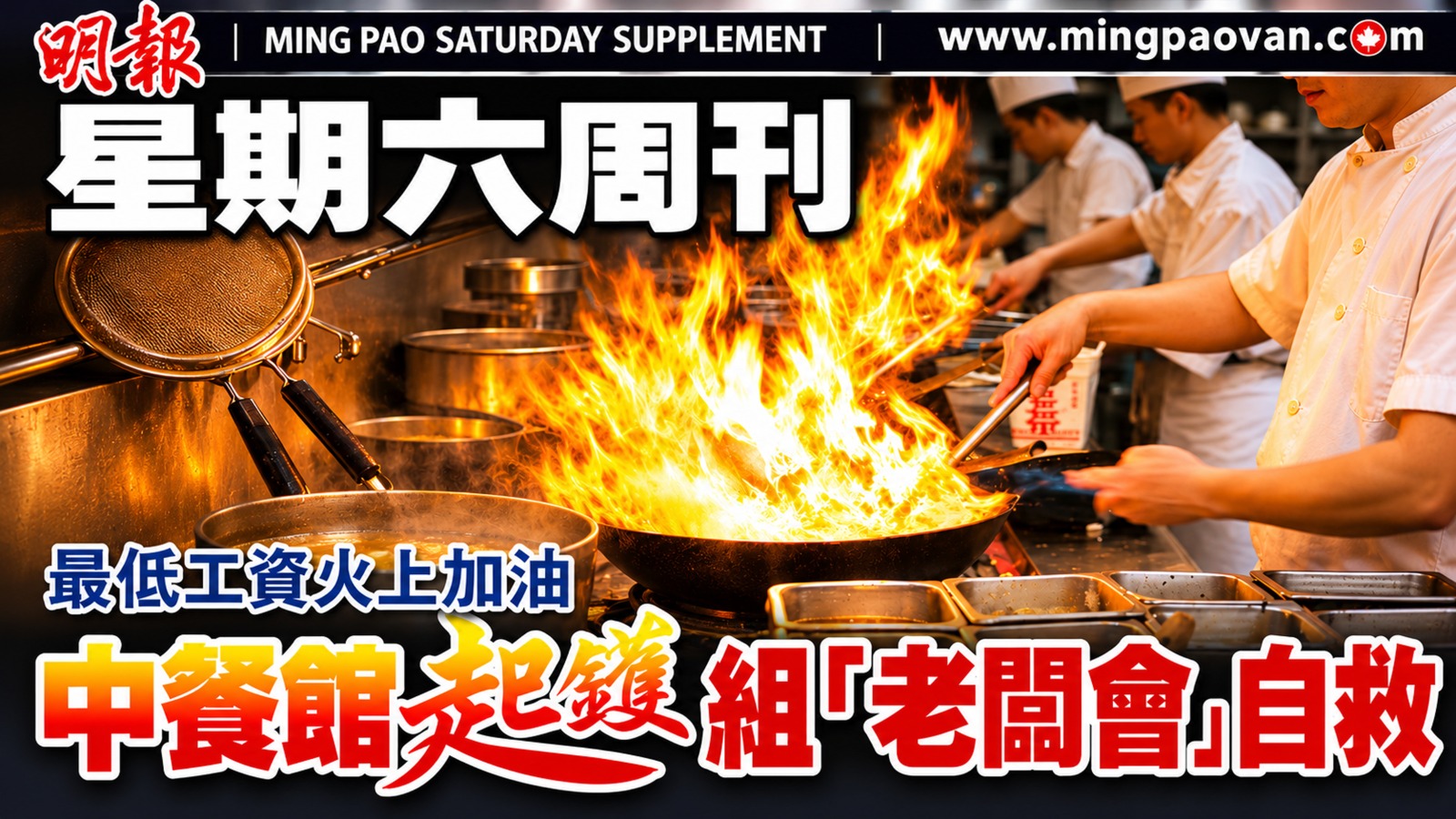
Minimum Wage Hike Adds Fuel to the Fire, Chinese Restaurants Unite to Form Owners’ Association in Bid to Surviv. British Columbia’s Chinese restaurant owners are joining forces.
ENGLISH TRANSLATION | MING PAO SATURDAY SUPPLEMENT ARTICLE | MAY 7, 2011
In an unprecedented move, more than 60 prominent restaurant owners have joined hands to establish a trade association. They aim to tackle four major blows facing the food-service industry: the Harmonized Sales Tax (HST), tougher impaired-driving legislation, an increase in the minimum wage, and rising costs driven by the broader economy. Together, they hope to build a business environment based on fair competition, mutual support and shared success.
On May 2, 2011, owners of major Chinese restaurants across Metro Vancouver announced the establishment of the B.C. Asian Restaurant and Café Owners Association. Putting an end to aggressive price-cutting was among the association’s first proposed measures to help the industry survive.
Running a restaurant has long been one of the main ways Chinese immigrants have earned a living overseas. In British Columbia, Chinese restaurants are often elaborately decorated and new establishments continue to open. Yet industry insiders say that soaring costs, destructive competition, labour shortages and high taxes have made it an achievement simply to avoid losing money.
One industry insider described the predicament bluntly: “If you want to do your friend a disservice, tell them to go into the restaurant business!”
With the association’s formation, one of its first proposed steps is to curb destructive price-cutting. Diners may find it harder to enjoy king crab at exceptionally low promotional prices in the future.
High costs, low prices, fewer customers, staff shortages and intense competition are among the biggest challenges facing Chinese restaurants.
Industry sources say that the economics of operating a local Chinese restaurant differ significantly from those of a mainstream Western restaurant. Ingredients and employee wages alone can account for more than 70% of total revenue. At some upscale Chinese restaurants, ingredients can cost as much as 40% of revenue, compared with about 25% at a typical Western restaurant.
Four Pressures Make It Difficult to Stay in Business
Following the devastating earthquake in Japan, premium food products popular among Chinese diners, including top-grade shark fin and dried scallops, became scarce. A rush by buyers pushed the prices of first-rate products up by 15%. Although British Columbia produces seafood, local prices are far from low: Japanese buyers are often willing to pay high prices for products such as sea urchin and shrimp roe, keeping overall prices elevated.
At the same time, inflation in the global economy has driven up the price of almost everything. A case of Chinese broccoli, which cost as much as C$30 two months earlier, rose to C$50. Other essentials for restaurants—including rice, flour, cooking oil and starch—also increased in price. Ingredient prices in January and February of 2011 were at least 10% higher than in the same period a year earlier.
The province’s introduction of the HST and what the article describes as some of Canada’s toughest impaired-driving laws had already affected restaurant business. The minimum-wage increase that took effect on May 1 caused a further ripple effect, as suppliers of services such as delivery and repairs also raised their fees. When additional rent increases are included, operators estimated that Chinese restaurants could face operating-cost increases of as much as 30%.
In other words, according to those in the industry, there was little money left to be made in running a Chinese restaurant.
More Operators, Fiercer Competition
According to conservative estimates from industry insiders, Metro Vancouver had no fewer than 1,000 Asian restaurants of various kinds. Even eating at a different one every day would not take a diner through them all in a year. That variety is one of Vancouver’s attractions, but it is also a source of frustration for restaurant owners: the number of operators has grown even though the customer market has not expanded accordingly.
Industry sources said that the influx of new immigrants had done relatively little to boost business at traditional Chinese restaurants. They observed that many immigrants from mainland China preferred to buy groceries and cook at home, while regular restaurant customers continued to be largely immigrants from Hong Kong and Taiwan.
There are, of course, diners willing to spend lavishly, but many customers are retirees and younger local wage-earners, and a substantial number have seen no corresponding increase in pay. Some families traditionally have adult children take their parents out for meals on weekends. Recently, however, higher consumer prices and expensive housing have eroded household spending power. Many people have reduced how often they go out for dim sum or meals; when they do visit Chinese restaurants on weekdays, they look for good food at an affordable price.
“Low prices,” “good taste” and “generous portions” have become like three tightening bands around the Monkey King’s head, leaving Chinese restaurant operators struggling to get by.
With too many restaurants chasing too few customers, supply and demand are out of balance. Some operators attempt to win customers by undercutting one another, resulting in ruinous competition and losses. Certain restaurants even sell seasonal seafood for less than supermarket prices. At the promotional prices previously charged for Alaskan king crab, operators could not make a profit. Yet when one restaurant cut prices deeply, others feared losing customers and felt compelled to keep their own prices low.
Several restaurants that closed earlier in the year reportedly could not find anyone willing to take over their premises—an unusual development. To some operators, this signalled that the industry was nearing a breaking point unless action was taken. One owner put it this way: “You compete against me, and I compete against you. In the end, we are the ones who destroy ourselves.”
Ending Destructive Price-Cutting
Against this background, restaurant owners who normally kept a low profile chose to step forward and publicly establish the B.C. Asian Restaurant and Café Owners Association. In its founding announcement, the association issued an unusually forceful appeal to fellow business owners: “Restaurant owners, do not remain silent any longer! Rather than merely struggling to survive, let us raise our voices so society can hear us and see that we are here!”
Described as the first local association of its kind for Asian restaurant owners, the organization attracted more than 60 Chinese restaurants within a week. Its membership included nearly all of Metro Vancouver’s major Chinese restaurants, with owners whose backgrounds spanned mainland China, Hong Kong and Taiwan.
The association’s stated objectives were to strengthen connections among employers in the food-service industry and related sectors; improve communication and the exchange of information; unite the industry and build collective strength so members could support one another; continuously improve the business environment; and enhance the industry’s public image and standing in society.
Founding president Mr. Chung (鍾日剛) acknowledged that people outside the industry often did not understand how difficult it was to operate a Chinese restaurant locally. Some entered the business without fully understanding the circumstances and only later discovered how difficult it was either to continue or to withdraw. In his view, Metro Vancouver’s Chinese restaurant market had already reached saturation, making it essential to find new revenue while controlling expenses.
The association planned a series of measures to help its members. First, it would consider adjusting selling prices and encourage operators to follow proper business practices and compete fairly. Mr. Chung stressed that the association was a non-profit organization with voluntary membership. Specific measures would be developed through discussion rather than imposed by force, and no adverse action would be taken against non-members.
Second, the association intended to explore collective purchasing and distribution to members, allowing operators to secure better terms and ease the burden of continually rising costs.
Third, Mr. Chung proposed attracting more customers from the wider community to expand the market. How best to communicate with those customers and provide appropriate service would require further consideration.
A familiar business saying holds that “business is business, even between father and son.” The association offered a different principle: “Those in the same trade are not enemies; business relationships can be as close as family.” Members referred to the analogy of chopsticks: one chopstick can be bent or broken easily, but a bundle of ten is difficult to break. They hoped the government and wider society would hear their concerns, understand their actions, and help safeguard the interests they shared.
Inaugural Provisional Organizing Committee
B.C. Asian Restaurant and Café Owners Association
Participating businesses (in no particular order):
Jade Seafood Restaurant
Sun Sui Wah Seafood Restaurant
Top Gun Group
Top Gun J&C Restaurant
Top Gun Hot Pot Restaurant
Garden City Hot Pot Restaurant
Golden Ocean Seafood Restaurant
Golden Swan Seafood Restaurant
Golden Oscar Restaurant
Tropinka Group
Grand Dynasty Seafood Restaurant
Tropinka Restaurant
Shi-Art Group
Shi-Art Chinese Cuisine
Shi-Art Express
Empire Seafood Restaurant
Empire Chinese Cuisine Restaurant
Specialty Chicken & Wonton House
Claypot Hotpot and B.B.Q.
Neptune Wonton Noodle
Neptune Restaurant Group
Mui Garden Restaurant
Gah Lok Dim Sum Ltd
Deer Garden Signatures
Rainflower Seafood Restaurant
Imperial Chinese Seafood Restaurant
Big Chef Restaurant
Harbour Spirit Restaurant
Victory Seafood Restaurant
HKYK Seafood Hotpot Restaurant
Top Shanghai Cuisine Restaurant
Bing Sheng Restaurant
Golden Sea City Restaurant
Come Along Seafood Restaurant
Southwest Seafood Restaurant
Chong Qing Restaurant
Western Lake Chinese Seafood Restaurant
Jade Dynasty Restaurant
Red Star Seafood Restaurant
Fisherman’s Terrace Seafood Restaurant
Shanghai River Restaurant
Golden Paramount Seafood Restaurant
Fortune Restaurant
Top Canton Cuisine Restaurant
Flamingo House Chinese Cuisine
Kam Do Bakery
Fortune Restaurant
Vivacity Restaurant
Continental Seafood Restaurant
Fortune House Seafood Restaurant
Fraser Court Seafood Restaurant
Prince Seafood Restaurant
Spicy Court Chinese Restaurant
Golden Great Wall Szechuan Restaurant
The One Restaurant
Gala Seafood Restaurant
California Café
Imperial Court Beijing & Szechuan Cuisine
Gingeri Chinese Cuisine
Ho Yuen Kee
Alvin Garden